What if the most powerful thing you could do for your mental health wasn’t to analyze your past — but to fully inhabit your present? That’s the quiet revolution at the heart of Gestalt therapy. And for women carrying the weight of trauma, addiction, depression, or emotional pain, it can be genuinely transformative. Exploring personal journeys of mental health recovery allows individuals to reconnect with their authentic selves. These experiences can foster resilience and hope, emphasizing the importance of embracing one’s current state rather than being anchored by the past. Ultimately, this shift in focus can lead to deeper healing and a more profound sense of well-being.
Gestalt therapy is a humanistic, present-focused form of psychotherapy that helps people develop self-awareness by exploring thoughts, emotions, and behaviors as they arise in the moment. For women, this approach can be especially powerful — helping you move through grief, trauma, and self-limiting patterns by experiencing them directly rather than just talking about them.
At The Rose House, Gestalt therapy is one of the evidence-based modalities woven into our clinical programming. Founded in 2007 by Dr. Marcie Chambers — a PhD psychologist — our 17-bed boutique residential program near Boulder, Colorado has offered women gender-specific, trauma-focused treatment for nearly two decades. We’re state licensed in Colorado for behavioral health and hold Joint Commission accreditation. Our clinical team, made up of PhD and master’s-level therapists, uses Gestalt alongside CBT, EMDR, DBT, and other modalities to meet each woman exactly where she is.
What Is Gestalt Therapy, Exactly?

Most forms of therapy ask you to reflect. Gestalt therapy asks you to feel — right now, in the room, in your body. Developed by Fritz Perls in the mid-20th century, Gestalt comes from the German word meaning “whole.” The approach holds that we can only understand ourselves as whole people — not as fragmented collections of symptoms, diagnoses, or past events.
Here’s the core ideunfinished business keeps us stuck. When emotions or experiences don’t get fully processed — grief that was never grieved, anger that was swallowed, love that was never safe to express — they don’t disappear. They surface in our relationships, our habits, our bodies, and our mental health. Gestalt therapy creates the conditions for that unfinished business to finally complete.
For women, this can feel like a homecoming. Women are often socialized to suppress, manage, or minimize their emotional experience. Gestalt gives you permission to bring all of it — the rage, the sadness, the longing, the confusion — into the room and work with it directly.
The four pillars of Gestalt therapy are:
- Awareness — Cultivating real-time consciousness of thoughts, feelings, and bodily sensations
- Present-Moment Focus — Grounding the therapeutic work in now, not in memory or anticipation
- Contact and Relationship — Exploring how you engage (or disengage) with others and the world
- Responsibility — Moving toward personal ownership of your experience and choices
The Six Core Principles of Gestalt
You’ll often hear these referenced in clinical contexts:
| Gestalt Principle | What It Means in Practice |
|---|---|
| Figure and Ground | What you focus on (figure) vs. what fades to background — awareness shapes perception |
| Closure | Our drive to complete unfinished experiences — especially emotional ones |
| Proximity | How nearness — in time, space, or relationship — influences how we understand things |
| Similarity | We tend to group similar experiences, feelings, or patterns together |
| Continuation | Our tendency to follow a direction or pattern once it’s established |
| Prägnanz (Simplicity) | We naturally seek the simplest, most stable interpretation of experience |
In a clinical setting, these principles help therapists understand how a woman organizes her inner world — and where she might be stuck in patterns that no longer serve her.
Why Gestalt Therapy Is Particularly Powerful for Women
Let’s be real: women often arrive in therapy after years of being told their emotional responses are too much. Too sensitive. Too reactive. Too intense. Approaches to treating depression in women must consider these unique emotional experiences. Tailoring therapeutic techniques can empower women to explore their feelings without fear of judgment. Additionally, support groups that focus on shared experiences can reinforce a sense of community and understanding. Recognizing signs of depression in women can be crucial in providing timely and effective support. Mental health professionals need to be trained to identify these signs, as many women might not voice their struggles openly. By fostering an environment where women feel safe to express their emotions, therapy can become a more impactful and healing journey.
Gestalt therapy doesn’t pathologize your emotional life. It says: your feelings are information. And it creates space for you to actually receive that information — rather than manage it away.
What makes Gestalt especially well-suited for women’s healing?
- Trauma is held in the body, not just the mind. Gestalt’s somatic, embodied focus helps women connect with the physical residue of trauma — tension, numbness, chronic pain, shallow breathing — and begin to release it
- Women often struggle to identify and name emotions. The present-moment awareness exercises in Gestalt therapy build that skill in real time, not just theoretically
- Relationship patterns are central. Gestalt’s focus on contact — how you show up in relationship — makes it ideal for working through co-dependency, attachment wounds, and relational trauma
- Voice work and expressive techniques — like the empty chair exercise and other Gestalt practices — allow women to externalize internal conflicts, move the energy of a traumatic experience, or say the things they were never allowed or able tosay
Client Spotlight
Maya had been to two treatment programs before she came to The Rose House — each one focused heavily on psychoeducation and group check-ins, but she left both times feeling like something essential had been missed. “I could talk about my childhood forever,” she said later, “but talking about it never actually changed anything.” In our residential program, she worked one-on-one, and in a group setting, with her primary therapist using Gestalt techniques, including the empty chair. For the first time, she had a conversation — really had it — with the mother who had never validated her pain. She didn’t leave that session with answers. She left with something better: a sense of completion that allowed her to start grieving rather than bracing. That was the beginning of her real recovery.
Gestalt Therapy vs. EMDR: Understanding the Difference

Both Gestalt and EMDR are used in trauma treatment, and both appear in our clinical programming at The Rose House. People often ask how they differ. Here’s a direct answer: EMDR is a structured, protocol-based therapy specifically designed to reprocess traumatic memories by reducing their emotional charge. It targets specific events. Gestalt doesn’t address trauma through memory reprocessing — it works by building present-moment awareness and completing unfinished emotional experiences, making it particularly valuable for relational and developmental trauma that doesn’t fit neatly into a single incident.
They aren’t competing approaches. They’re complementary. Many women benefit from both — EMDR to process specific trauma events and Gestalt to develop the self-awareness and relational insight that sustains recovery over time. Womenfocused rehabilitation strategies play a crucial role in supporting recovery journeys. These approaches can be tailored to address the unique challenges women face. By incorporating specific therapeutic techniques and fostering a collaborative environment, practitioners can enhance the overall effectiveness of the recovery process.
Who Benefits Most — and Who Should Be Cautious
Does Gestalt therapy work for everyone? Not in every context. Here’s what the clinical picture actually looks like.
Women who tend to benefit most from Gestalt therapy:
- Those with relational trauma, attachment wounds, or co-dependency
- Women experiencing grief, loss, or prolonged emotional pain
- Women who feel emotionally numb or disconnected from their bodies
- Those dealing with anxiety, depression, or identity struggles
- Women who’ve been through other treatment but feel like they’ve never reached the root
Women who may need additional stabilization first:
Gestalt therapy is highly experiential and emphasizes direct emotional contact — which is powerful but also activating. Women experiencing active psychosis, severe dissociation, or acute psychiatric crisis may need stabilization at a higher level of care before engaging in experiential modalities. At The Rose House, your clinical team conducts a thorough assessment at admission to determine which modalities are appropriate for you and when. No one-size-fits-all. Ever.
Gestalt at The Rose House: How It Fits the Whole Picture
What does Gestalt therapy actually look like inside our program?
Our women don’t just attend one type of therapy — they engage in 35+ hours per week of individualized clinical work. Gestalt is one thread in a rich therapeutic fabric that includes individual psychotherapy, trauma-focused group therapy, DBT skills, EMDR, somatic therapies, equine therapy, and daily fitness and wellness programming.
So what does this actually look like day to day?
In individual sessions, your primary therapist might use Gestalt to explore how a current relationship pattern connects to something you’re carrying from the past — not by excavating the past intellectually, but by bringing it alive in the present moment. In group, experiential Gestalt exercises invite you to practice contact, voice, and awareness in the presence of other women who are doing the same work. That community piece isn’t incidental. Women heal in connection with other women.
Our campus in Boulder County provides a setting that supports this kind of deep, present-moment work — four peaceful acres of open space where the noise of the outside world falls away and you can finally hear yourself again.
Client Spotlight
Christy’s husband reached out to The Rose House after two years of watching his wife cycle through depression, emotional shutdowns, and increasing isolation. She’d been in outpatient therapy for years — competent therapists, but weekly 50-minute sessions had a ceiling. She came to our residential program with a primary diagnosis of PTSD and major depressive disorder, no substance use. She was skeptical. Within six weeks, she told her primary therapist: “I feel like I’m starting to live inside my own life again.” The Gestalt work helped her identify how she’d been splitting herself — performing okayness for everyone around her while being completely absent from herself. Her husband joined family therapy sessions and said the change he witnessed was “like watching someone come back to life.” She graduated after three months and transitioned into our continuing care program in Lafayette.
What Sets The Rose House Apart in Women’s Mental Health Treatment
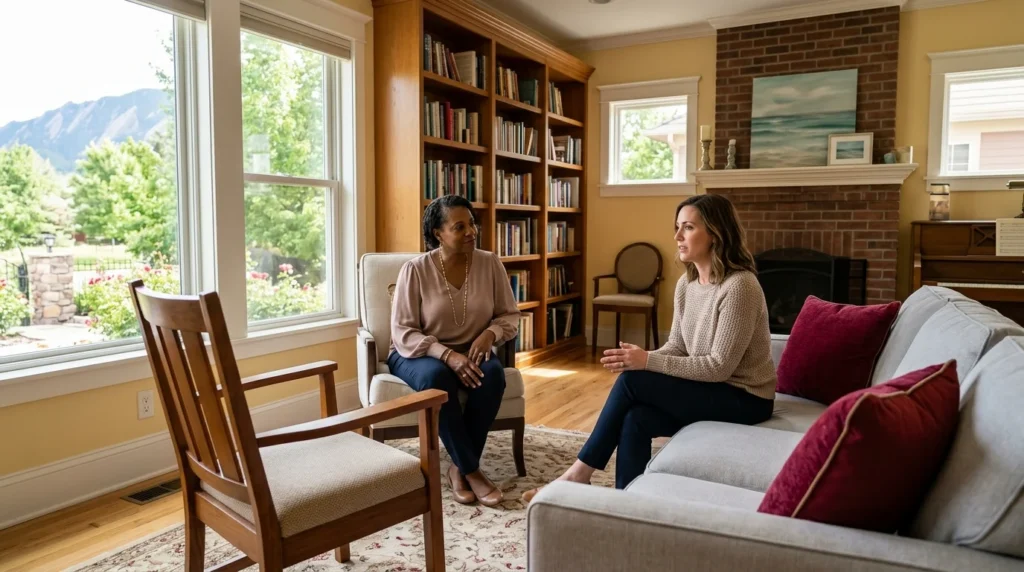
When you’re looking for treatment, trust matters. We know that.
Our clinical team brings decades of combined experience in women’s trauma, dual diagnosis treatment, and evidence-based modalities — including Gestalt, EMDR, IFS, DBT, and somatic therapies. We don’t mix approaches haphazardly. Each woman receives a thorough clinical assessment and an individualized treatment plan that determines which modalities will best serve her healing. Mental health challenges for women often manifest differently than for men, necessitating a tailored approach. Our team is particularly attuned to these unique needs, ensuring that the treatment provided is relevant and effective. By addressing these challenges head-on, we empower women to navigate their healing journeys with confidence and resilience.
The Rose House has been women-only since the day we opened in 2007. That’s not a marketing point — it’s a clinical commitment. Research consistently shows that gender-specific treatment produces better outcomes for women with co-occurring disorders and trauma histories. Our all-women community means every clinical decision, every therapeutic approach, and every group session is designed with the specific psychological, relational, and emotional needs of women in mind.
We hold Joint Commission accreditation and state licensure in Colorado for behavioral health — including primary mental health and substance use disorder. Our staff of 20+ includes licensed professional counselors, clinical social workers, addiction specialists, and board-certified medical providers.
And here’s something we’re proud of: the continuing care program available exclusively to our graduates creates a seamless continuum of care — residential treatment followed by six months of supported transition into real life, with the same team, in the same community. That continuity is rare. And it matters for lasting recovery.
Frequently Asked Questions
The four pillars of Gestalt therapy are awareness (noticing thoughts, feelings, and sensations in real time), present-moment focus (working with what’s happening now rather than then), contact and relationship (exploring how you engage with others and the world), and personal responsibility (taking ownership of your experience and choices).
Gestalt therapy may not be appropriate as a primary modality for women experiencing active psychosis, severe dissociation, or acute psychiatric crisis — as its experiential nature can be activating before adequate stabilization is in place. A thorough clinical assessment should always guide which therapeutic modalities are used and when.
EMDR is a structured, protocol-based therapy designed to reprocess specific traumatic memories. Gestalt therapy builds present-moment awareness and helps complete unfinished emotional experiences — particularly effective for relational and developmental trauma. They’re often used together in comprehensive trauma treatment, with each serving a different but complementary function.
Gestalt therapy has been criticized for having a smaller body of empirical research compared to CBT or DBT. Its experiential techniques can also feel emotionally intense, which isn’t suitable for every person or every stage of treatment. That said, it has a strong foundation in humanistic psychology and decades of clinical use across trauma, relationship, and mental health treatment.
Yes. Gestalt therapy is one of the evidence-based modalities woven into our individualized clinical programming at The Rose House. It’s used in individual psychotherapy and experiential group settings alongside EMDR, DBT, IFS, somatic therapies, and other approaches — always guided by each woman’s clinical assessment and treatment plan.
Absolutely. The Rose House accepts women with primary mental health diagnoses — including depression, anxiety, PTSD, bipolar disorder, borderline personality disorder, and emotional dysregulation — even without a substance use disorder component. You don’t have to be struggling with addiction to belong here.
Our residential program has a minimum of 90 days. The ideal treatment plan — for women who are ready to do deep, sustained work — is nine months total: three months residential followed by six months in our exclusive step-down program in Lafayette, Colorado. That extended care model is what produces lasting change, not short-term stabilization.